The 2025 Open Science Free Research Software Awards


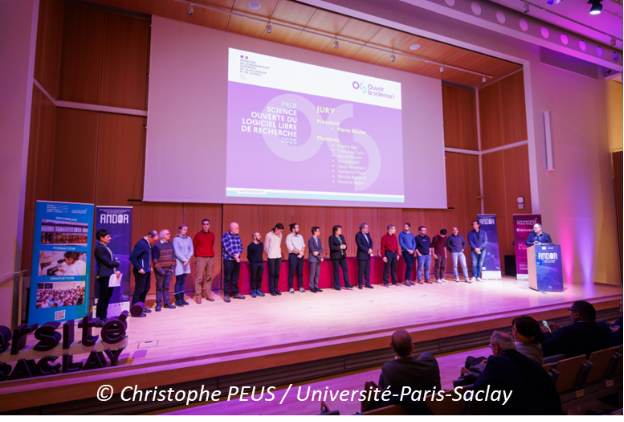
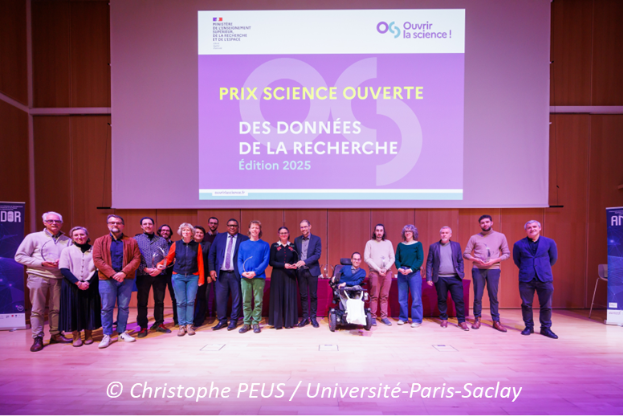
The 4th edition of the Ministry of Higher Education, Research and Space’s (MESRE) Open Science Free Research Software Awards was held on December 1st 2025 at Paris-Saclay University during the National Research Data Conference (Andor 2025).
The Open Science Free Research Software Award showcases research projects and teams that work to develop and disseminate free software and contribute to the construction of a common good which is of significant importance. This award recognises the production of free software as a contribution and also a research result in itself. It rewards exceptional or highly promising achievements that can inspire both the scientific community and society as a whole. Like the Open Science Research Data Awards and the Open Science Awards for PhD Theses, Open Science Free Research Software Awards are part of the Second French Plan for Open Science.
This year, eight winners were recognised in four different categories:
- ‘Scientific and Technical’
- ‘Community’
- ‘Documentation’
- ‘Jury’s Favourite’ – for exemplary projects that combine several of these dimensions.
- The jury recognised the achievements of both already well known and promising projects, and also identified a promising project in each category.
‘Scientific and technical’ category
GNU MPFR – Scientific computing with arbitrary precision
GNU MPFR is a free (LGPLv3) library for arbitrary-precision floating-point computation, incorporating the best ideas from the IEEE 754 standard, such as correct rounding. It thus enables reliable and reproducible calculations, regardless of the computer and processor used, or for analysing numerical algorithms with control over the precision of each intermediate calculation.
Over the past 25 years, GNU MPFR has become an essential library in the field of arbitrary-precision scientific computing. GNU MPFR is used, in particular, by the Gfortran and GCC compilers, the MPFI and GNU Octave interval arithmetic libraries, the Arb arbitrary precision ball library, the CEA’s Fluctuat tool, the GNOME calculator, the Julia language, several computer algebra systems (Macaulay 2, Magma, Maple, Mathemagix, Sage). GNU MPFR is distributed with all Linux distributions.
Promising project: QUantitative Modelling of Inflection (Qumin) – Study of language inflection
Qumin is a free Python package (GPLv3) that quantitatively models the inflectional morphology of languages, i.e. the way words are declined and conjugated. By providing Qumin with tables listing all the forms of words in a language, researchers can quickly draw up a portrait of that language. Qumin is a computational linguistics research tool that enables researchers to analyse regularities and variations in the grammatical systems of the world’s languages. Efforts to improve interoperability (particularly with the Paralex data format) encourage researchers to make their research reproducible, from data creation to analysis. Thanks to the adoption of standard data formats (Paralex) and tools like frictionless, many datasets are shared by researchers and can be used by Qumin. The software was initially developed in the framework of a thesis and is now used by master’s students and linguists with no computer science training, both in France and other countries.
‘Community’ category
Aladin Lite – An interactive sky atlas
Aladin Lite is a free (GPLv3) interactive sky atlas that is accessible directly from a web browser. It enables users to zoom in, explore and view astronomical data like those from the European observatories Gaia and Euclid. Aladin Lite is easy to integrate into other sites or projects, offering astronomers, physicists, enthusiasts or the curious a gateway to the riches of the sky. It is interoperable and, indeed, many web portals use it spontaneously. Aladin Lite is based on data format and communication protocol standards that make it possible to offer everyone large volumes of data generated by observatories around the world. This library follows the FAIR4RS principles.
Promising: DifferentiationInterface.jl – A unified interface for automatic differentiation algorithms
DifferentiationInterface.jl, a free library licensed under MIT in the Julia language, provides a unified interface for automatic differentiation algorithms. Automatic differentiation consists of precisely calculating how a function varies, a key operation in modelling, simulation and minimisation tools. Despite its young age (project started in 2024), today nearly a thousand Julia packages use DifferentiationInterface.jl (directly or indirectly), an impressive adoption rate in the academic and industrial community that uses the Julia language.
Category: ‘Documentation’
Pharo – An object-oriented programming language and environment
Pharo is a free programming language which is licensed under MIT and is the follow-up to Smalltalk in which everything is an object. It provides an interactive environment that allows users to code, test and modify live, without interruption. It is simple, powerful and designed for learning, research and development. Pharo‘s documentation is highly comprehensive and provides a range of resources in various formats. It covers all topics related to Pharo in terms of installation, use and contribution. Pharo also provides two comprehensive MOOCs on the environment and its object-oriented programming. Finally, books also contribute to Pharo‘s documentation repository.
Promising: NeuRon Virtualizer – Modelling the electrical behaviour of peripheral nerves
NeuRon Virtualizer is a free tool, licensed under CeCILL-C, which simulates the electrical behaviour of peripheral nerves. It allows users to model their response to different electrical stimuli and explore these phenomena interactively, aiding research and development of innovative therapies. It incorporates scientifically validated biophysical models and relies solely on free libraries (Gmsh, FEniCS, NEURON). The documentation on NeuRon Virtualizer is comprehensive, structured and designed to meet the needs of several categories of users, from beginners to experts and future developers. This documentation includes a wide range of usage examples covering different features of the software.
‘Jury’s coup de Coeur/Favourite’ category
HyperSpy – Interactive analysis of complex data in physical sciences
HyperSpy is a free library for Python, licensed under GPLv3, which helps materials science researchers analyse and visualise complex data like multidimensional data sets. It was developed over a period of over 18 years and is now a benchmark tool in this field. It facilitates the exploration, interpretation and sharing of this type of data. The impact of HyperSpy extends beyond academia and research to industry. In addition, its documentation is comprehensive and complies with accessibility standards. There is also significant support offered to the user community including training, hackathons, schools, direct communication from the team.
Promising: Spatially distributed Modelling and ASsimilation for Hydrology (SMASH) – Simulation of hydrological phenomena
SMASH is a free (GPLv3) library for numerical simulation of hydrological phenomena. Scientifically and technically, SMASH enables hybrid conceptual-physical-AI approaches and can be used for complex, multi-basin applications. Its documentation facilitates its use by researchers and also by engineers in charge of operational subjects like Vigicrues. SMASH has therefore had a strong national academic, societal and industrial impact, and is beginning to make its mark abroad.
Jury
The jury was made up of the following members:
- Pierre Boulet, Jury President | University professor | University of Lille and Vice-President for Digital Technology at the same university
- Brigitte Bigi, CNRS associate research professor | Aix Marseille University
- Francoise Conil, CNRS research engineer | University of Lyon 1
- Benoit Garçon, founder of and consultant with La Formule Nuagique
- Bruno Khélifi, CNRS associate research professor | Paris Diderot University
- Lucas Nussbaum, associate research professor | Inria
- Guillaume Plique, research engineer | Médialab, SciencePo, Paris
- Nicolas Roelandt, research engineer | Gustave Eiffel University
- Florence Sèdes, university professor | University of Toulouse.
Find out more:
- The MESRE website page presenting the winners of the Open Science 2025 Data Award (in French): https://www.enseignementsup-recherche.gouv.fr/fr/remise-des-prix-science-ouverte-edition-2025-100469#logiciel
- All the awards and winners: https://www.ouvrirlascience.fr/category/open-source-software-prices/