The 2025 Open Science Research Data Awards


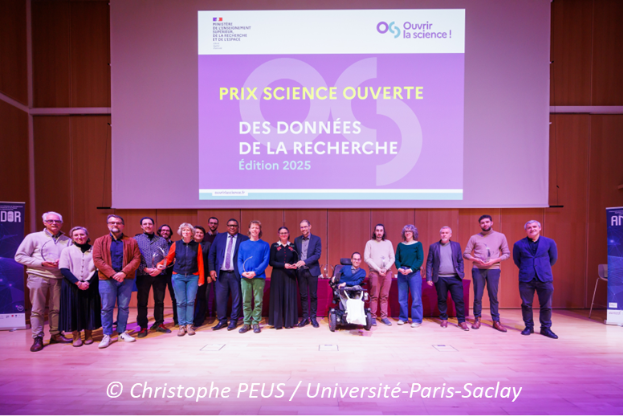
The Ministry of Higher Education, Research and Space (MESRE) presented the fourth edition of the Open Science Research Data Awards on December 1st 2025 at Paris-Saclay University during the National Research Data Conference (Andor 2025).
This award highlights researchers, projects and research teams involved in the management and dissemination of research data and who – in some cases – reuse already available data in their research. Like the Open Science Free Research Software Awards and the Open Science Awards for PhD Theses, the Open Science Research Data Awards are part of the second French Plan for Open Science.
Eight winners were recognised in three different categories this year:
- The ‘Creating a Missing Dataset’ award recognised two exemplary projects that have made new datasets available in response to a specific scientific requirement.
- The ‘Creating the conditions for reuse’ award recognised four projects for their exemplary work in managing research data to make it reusable.
- The ‘Special Jury Prize’ was awarded to two exemplary projects for making data available and enriching them.
Category: ‘Creating a missing dataset’
Corpus les Vocaux – French voice messages
The Corpus les Vocaux project is the first corpus of voice messages in French. It consists of spontaneous, unsupervised oral data. Sharing this corpus helps enrich the description of natural language and its variations. The data is highly original and shared with a strong focus on documentation. The methodology is clear and robust.
This project has received several grants and is being developed at Université de Lorraine, the University of Strasbourg and the University of Liège.
Subwork – Data on workers in France
The Subwork project provides an original database listing the structure, geography and social characteristics of workers in France in 2008 and 2018. Subwork promotes and disseminates quantitative social studies on several geographical scales, with data at the intersection of sociology, geography and urban studies.
This project is led by a team from the University of Nantes.
Category: ‘Creating the right conditions for reuse’
RPG Explorer – Data on agricultural land use
The RPG Explorer project uses agricultural land use data from the European Common Agricultural Policy (CAP) collected annually at the national level. RPG Explorer reconstructs crop sequences from annual records. Making the data available in a standardised spatial format improves their accessibility for non-specialists in Geographic Information Systems (GIS). The data are relevant for a wide range of scientific and social reuses.
RPG Explorer is supported by a team from the National Research Institute for Agriculture, Food and Environment (INRAE) and AgroParisTech.
The e-NDP application – Digitised medieval registers from Notre-Dame de Paris
The e-NDP project is renewing knowledge about Notre-Dame de Paris through the digital publication of 26 medieval registers. The application’s structure is natively based on FAIR principles, enables users to search this unique corpus and provides access to all resources produced and documentation. The project uses HTR (Handwritten Text Recognition) and its processes are clear, documented and potentially reproducible.
The e-NDP application is being developed at the École nationale des chartes – PSL and has received funding from the ANR in the framework of a project coordinated by Université Paris Cité.
ArchiMed platform – Medical images from over 100 university hospitals
The ArchiMed platform is dedicated to the centralisation, storage, annotation and provision of medical images from over 100 university hospitals for research projects. It facilitates access to, traceability and analysis of imaging data, in accordance with regulatory requirements as regards sharing particularly sensitive personal data in biological health.
The ArchiMed platform is developed by the Nancy University Hospital Centre, Inserm and Université de Lorraine.
Seatizen – Coral reef ecosystem imaging data
The Seatizen project collects and makes available imaging data on coral ecosystems for the purpose of monitoring changes in biodiversity and factors in a robust implementation of FAIR principles. The data are standardised, georeferenced and shared with the scientific community and the general public for a variety of uses, including AI models.
The Seatizen project has received several grants and is supported by the French Research Institute for Exploitation of the Sea (Ifremer), the National Institute for Research in Digital Science and Technology (Inria), the Research Institute for Development (IRD) and the CNRS.
Category: ‘Special Jury Prize’
Panel de Caen – Monitoring 87 young people between 1995 and 2015
The Panel de Caen project provides the scientific community with data from a survey launched in 1995 with a panel of 87 young people. By following these young people’s life trajectories over 20 years and analysing changes in their relational networks, this project has filled a gap in sociological research, thematically and methodologically, by carrying out qualitative and quantitative surveys.
The work is remarkable because of its scope and the efforts made to share the data, in particular through pseudonymisation.
The Panel de Caen project is supported by numerous funding sources and involves three teams: CDSP (Sciences Po / CNRS), LEST (CNRS/Aix Marseille University), and the Panel de Caen research collective.
Rivages normands – Coastal groundwater and water risk models
The Rivages normands project collects and shares data on coastal groundwater that are enriched by water risk models for the territories. This data contributes to research in earth system sciences, biodiversity and climate effects, and assists local authorities in their decision-making. The project has both scientific and social significance.
The project is supported by the University of Rennes, the CNRS, the University of Caen Normandy, the DREAL (Regional Directorate for Environment, Planning and Housing) from Normandy and the Seine Normandy Water Agency.
Jury
The jury was made up of the following members:
- Grégoire Rey, Jury President | Research engineer | Inserm and director of the France Cohortes National Infrastructure
- Hélène Chiapello, research engineer | INRAE, French Institute of Bioinformatics (IFB)
- Olivier Marlet, CNRS research engineer at the Laboratoire Archéologie et Territoires (LAT) | University of Tours
- Sébastien Oliveau, CNRS research professor | director of the Paris-Saclay MSH
- Pierre Poulain, senior lecturer | Université Paris Cité & CNRS
- Etienne Roesch, university professor | University of Reading
- Magalie Weber, research engineer | INRAE – Biopolymères Interactions Assemblages (BIA)
Find out more:
- MESRE website page presenting the winners of the Open Science Research Data Award (in French): https://www.enseignementsup-recherche.gouv.fr/fr/remise-des-prix-science-ouverte-edition-2025-100469#donnees
- All the awards and winners: https://www.ouvrirlascience.fr/category/openscience-prices/